“I tell a student that the most important class you can take is technique. A great chef is first a great technician. If you are a jeweler, or a surgeon or a cook, you have to know the trade in your hand. You have to learn the process. You learn it through endless repetition until it belongs to you.”
-Jacques Pepín
Orientation was set for Monday, June 30th, and I chose to walk to school—partly for practicality, mostly for romance. There was a route that carried me past the Arc de Triomphe and onward toward the shimmering outline of the Eiffel Tower, as if Paris herself were gently escorting me to class. Over the next nine months, I would walk that same path nearly 250 times, though it never once felt repetitive.
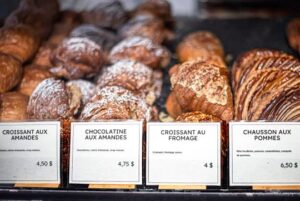
I avoided Ubers and the métro whenever I could. The streets had too much to offer—ornate façades that seemed to demand your attention, wrought-iron balconies draped in effortless Parisian elegance, the early morning scent of bakeries just opening their doors, and the poissonneries meticulously arranging fish over crushed ice as if preparing for a minuet.
Walking wasn’t just transportation; it was part of the experience. Part of the ritual.
And, if I’m being completely honest, it was also a necessity. There was simply no other way to justify—or survive—the sheer volume of butter, cream, and “leftovers” from class that I so enthusiastically, and without restraint, consumed.
Still, no matter how many times I made that walk, nothing compared to that first crossing of the Seine. Near the petite Statue of Liberty, I paused, taking it all in—the light on the water, the hum of the city, the unmistakable sense that I had arrived somewhere meaningful. And then, just beyond it, I saw the school for the first time.
I can’t remember the last time I felt that excited… and that nervous.
When you walk into the school, you’re greeted by two or three receptionists who can only be described as effortlessly chic—and just the right amount of sassy. I fell in love with them immediately.
Some had bold streaks of blue woven through their hair like it was the most natural thing in the world. Others perfected the art of barely looking up from their papers when you approached, as if acknowledging you was entirely optional. It was equal parts intimidating and fabulous.
But as the story unfolds, these women became something else entirely—my unexpected saviors.
They handled a constant stream of questions, confusion, minor crises, and the occasional full-blown meltdown with understated grace. And somehow, no matter what chaos was unfolding around them, they always managed a smile, a quick laugh, or a perfectly timed bonjour—sometimes even a ciao bella—right when you needed it most.
There was a hum in the air—the kind that tells you something meaningful is about to begin, whether you’re ready or not. We were ushered into a classroom with forty or fifty people, all of us slightly stiff, slightly curious, clutching whatever version of confidence we had managed to pack in our suitcases.
Introductions were required. Of course they were.
One by one, we stood and told our stories to a room full of strangers who would soon know us in far more intimate ways—how we handle pressure, failure… butter. It was a true melting pot of nationalities, accents weaving together in a way that felt both exhilarating and slightly disorienting.
And then there was me—very aware that I was not just older, but noticeably older. Not by a polite handful of years. I’m talking I could have had most of these kids in my thirties and still made it to school drop-off on time.
After introductions—and some portion of orientation I’m quite certain was important but has since evaporated—we were led upstairs for uniform fittings and a tour.
The Le Cordon Bleu uniform is not just clothing; it’s a system. Precise. Structured. Almost militaristic. The crisp white jacket is just thick enough to withstand heat and chaos (but not turmeric or saffron, which I learned later, to my chagrin). Heavy cotton pants, apron tied just so, neckerchief secured with intention. Everything has a purpose. Everything has a rule.
There is no room for interpretation. Or vanity.
Hair pulled back. Hairnet—eerily reminiscent of middle school cafeteria ladies. Super chic. Then a hat placed on top, just to complete the look.
The first time I put it on, I caught a glimpse of myself and paused. It wasn’t just a uniform—it was a declaration. Somewhere between the weight of the jacket and the tightness of the collar, it became very clear: I had stepped into an entirely new identity.
And I liked it.
We also picked up our knife kits, which—no exaggeration—felt more exciting than Christmas morning. There’s something about being handed a proper set of tools that makes everything suddenly feel real.
The kit was all business. A chef’s knife that demanded respect. A paring knife for precision. A serrated knife I would soon learn to appreciate far more than I ever had. A honing steel—initially underestimated—that quickly proved to be the difference between control and chaos.
Everything neatly wrapped. Organized. Intentional.
Holding it, I felt both excited and slightly terrified. These weren’t just tools—they were expectations.
And unlike Christmas morning, there were no instructions. Just a room full of people, a ticking clock, and the very real possibility of hurting yourself if you weren’t paying attention—which, as it turns out, I wasn’t… repeatedly.
There were nicks, cuts, burns, and a few moments where I seriously questioned my life choices—all packed neatly into those first few months. More on that to come.
The kitchens themselves were not romantic in the way I had imagined. No copper pots glinting in warm light. No rustic charm.
They were something else entirely.
Sleek. Precise. Almost clinical. Stainless steel everywhere. Long rows of identical workstations, each equipped with exactly what you need and absolutely nothing you don’t.
Everything had its place. And more importantly, everything was expected to return to it.
These kitchens were built for discipline.
You didn’t gather—you worked. You replicated. You failed. You tried again.
Upstairs, chefs demonstrated techniques with quiet intensity while we scribbled notes as fast as possible. Then downstairs, we attempted to recreate what we had just witnessed—usually with far less grace.
The building itself was modern—glass, aluminum, efficient. Even a rooftop garden, reminding you that for all the structure, food still begins with something alive.
But what stayed with me most was the energy.
The hum of burners. The rhythm of knives. The quiet urgency of the clock.
It wasn’t cozy.
It wasn’t forgiving.
But it was alive.
And somewhere in that environment, you realize—you’re not just learning to cook.
You’re being shaped.
Luckily, after my first day of orientation, I came home to Doodle waiting for me.
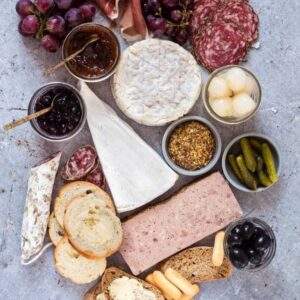
A true foodie—just like me—she had spent the day wandering through markets and fromageries, gathering little treasures along the way. By the time I walked in, she had assembled an extraordinary “Welcome back from your first day of school” charcuterie board, complete with a bottle of French wine that probably cost less than a Coke Zero.
God—the French wine.
It was one of my first real introductions to a quiet, humbling truth: in France, exceptional wine isn’t reserved for special occasions. It’s just… Tuesday.
Uncomplicated. Unpretentious. And somehow better than anything I had convinced myself was “good” back home.
I remember thinking, Have we been doing this all wrong?
There were cheeses in various stages of personality—from mild and creamy to unapologetically assertive—perfectly sliced saucisson, crusty baguette still warm, and little extras that felt like they had insisted on being included.
It was thoughtful. Indulgent. Exactly what I needed.
And in that moment, standing in my tiny Paris kitchen, still slightly overwhelmed from the day, it felt like the most perfect kind of welcome—not just back to the apartment, but into this entirely new chapter.
And maybe even more than that, I felt deeply, quietly grateful to have my sister there to share it with me.
Recipe
A Perfect French Charcuterie Board
This is not a recipe, per se, but a guide on how to build the perfect French charcuterie board. A perfect French charcuterie board isn’t about abundance—it’s about balance, restraint, and really good choices. The French don’t pile everything on; they curate.
Here’s how to build one that feels effortlessly Parisian.
Aim for 3–5 cheeses, each with a different personality:
- Soft & creamy: Camembert or Brie
- Firm & nutty: Comté or Gruyère
- Blue (bold): Roquefort
- Goat cheese (fresh & tangy): Chèvre
Let them sit out 30–45 minutes before serving. Cold cheese is a crime in France.
Choose 2–3 meats:
- Saucisson sec (your essential French salami)
- Jambon de Bayonne (silky, delicate ham)
- Optional: Pâté or rillettes for richness
Think quality over quantity. This isn’t an American deli platter.
Bread is non-negotiable
- Fresh baguette (always)
- Maybe a rustic country loaf
Skip crackers if you want it to feel truly French.
A few extras… Keep it minimal and intentional:
- Cornichons (tiny tart pickles – essential)
- Fresh fruit (grapes or sliced figs)
- Nuts (walnuts or almonds)
- Honey or fig jam (just one, not five)
The wine (this is where the magic happens!)
- With soft cheeses → Chardonnay or Champagne
- With Comté → White Burgundy
- With charcuterie → Light red (Pinot Noir, Beaujolais)
- With blue cheese → Sauternes (if you want to be very French about it)
And yes… it can absolutely cost less than a Coke Zero and still be incredible.
The French secret – this is key…
- Don’t overcrowd the board
- Let ingredients breathe
- No symmetry required—it should feel casual, not staged
- Serve it with conversation, not perfection!